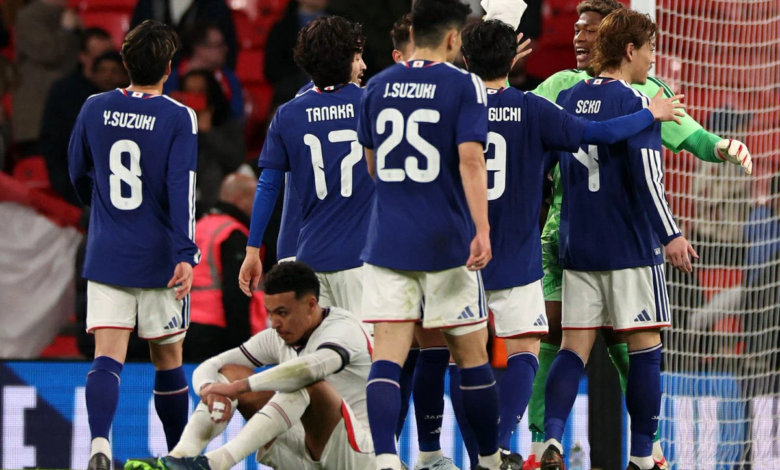

A moral and historic victory in the heart of Wembley
The Japanese national football team achieved a significant morale-boosting and historic victory over England, winning 1-0 in a thrilling friendly match at Wembley Stadium in London. This victory was more than just a win in a preparatory game; it carried profound messages reflecting the remarkable progress of Asian football, and Japanese football in particular. The lone goal of the match came in the 23rd minute courtesy of the brilliant Kaoru Mitoma, giving the "Samurai Blue" a tremendous morale boost ahead of the upcoming World Cup and reinforcing their recent positive record of remaining undefeated against major European teams.
Moriyasu reminisces: Look where we are today
Following the final whistle, Japan's head coach, Hajime Moriyasu, captured the attention of the international press with a moving and profound statement, beginning with, "Look where we are today." Moriyasu reminisced, saying, "Thirty-six years ago, I traveled to England for a training stint with Manchester United. At that time, everyone looked at us with astonishment and wondered, 'Can the Japanese even play football?'" The veteran coach added, his voice brimming with pride, "And today, from the heart of Wembley Stadium, I answer them: Yes, we can play, and we can win too." Moriyasu emphasized that this achievement was not a matter of chance, but rather the fruit of tireless work. He pointed out that when the Japanese set their sights on a goal, they inevitably reach it, expressing his unwavering faith in the strategy devised by the Japan Football Association.
Historical context: The 100-year vision bears fruit
To understand the significance of this statement, we must return to the historical context of Japanese football. In the late 1980s, football in Japan was an amateur sport limited to corporate teams, with little to no professionalism. However, in 1992, the Japan Football Association launched an ambitious plan known as the "100-Year Vision," which aimed to build a strong professional league (the J-League, which began in 1993), develop infrastructure, export players to Europe, and ultimately achieve the goal of winning the World Cup by 2092. Moriyasu's statement reflects the success of this vision, which transformed Japan from a relatively unknown footballing nation into a global powerhouse.
The impact of victory: a warning message to the world and the symbolism of Mitoma
This victory carries significant weight on several levels. Domestically, it raises the expectations of Japanese fans, who now have faith in their national team's ability to compete with the best. Regionally, it solidifies Japan's position as a leader in Asia. Internationally, this triumph confirms that Japan's previous victories against teams of the caliber of Germany and Spain in the 2022 World Cup were not a fluke, but rather the result of sustained development. Adding to the symbolic significance of the event, the goal scorer, Kaoru Mitoma, represents a purely Japanese success story. His outstanding performances with Brighton in the English Premier League have demonstrated that Japanese players have become decisive stars who can make a difference in the world's strongest leagues.