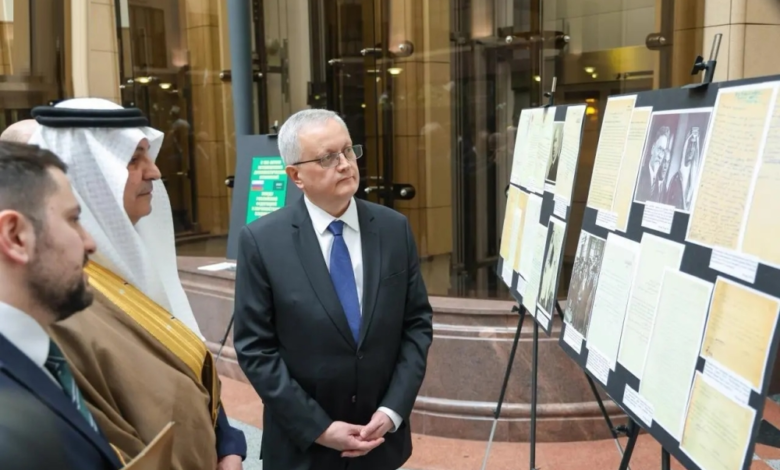

In a move reflecting the depth of long-standing historical ties, the Russian Ministry of Foreign Affairs, in cooperation with the King Abdulaziz Foundation, celebrated the centennial of diplomatic relations between the Kingdom of Saudi Arabia and the Russian Federation. A special ceremony was held in Moscow, during which an exhibition of rare photographs and historical documents chronicling a century of cooperation and mutual understanding was inaugurated.
The ceremony was attended by high-level diplomats, led by the Deputy Foreign Minister of the Russian Federation, Georgy Borisenko, and the Ambassador of the Custodian of the Two Holy Mosques to Russia, Sami bin Mohammed Al-Sadhan, along with a number of officials and diplomats from both countries.
Historical background: Roots extending back to 1926
The roots of Saudi-Russian relations trace back to February 1926, when the Soviet Union became the first country in the world to recognize the Kingdom of Hejaz and Nejd and its dependencies, which later became the Kingdom of Saudi Arabia. This early recognition formed the cornerstone of a relationship that has gone through various phases, influenced by global geopolitical shifts, particularly during the Cold War. However, it experienced a new and strong impetus with the resumption of full diplomatic relations in the 1990s, evolving since then into a multifaceted strategic partnership.
Strategic importance and global impact
Relations between Riyadh and Moscow are of paramount importance both regionally and internationally. Both countries are among the world's largest energy producers and exporters, and their cooperation within the OPEC+ framework plays a pivotal role in stabilizing global oil markets, which directly impacts the global economy. Furthermore, their coordination is growing in international forums such as the G20 and BRICS, reinforcing their role in shaping a multipolar world order. This partnership aligns with the objectives of Saudi Arabia's Vision 2030, which aims to diversify the economy and build strong international partnerships.
A promising future and growing cooperation
In his remarks at the ceremony, Ambassador Al-Sadhan emphasized that the exhibition presents a unique opportunity to showcase the significant milestones in the history of both countries, noting that relations are witnessing rapid growth across all sectors. He stated, “This year, the Kingdom and Russia are commemorating their centennial with celebrations and activities encompassing economic, cultural, tourism, and sporting aspects, paving the way for a new phase of ambitious strategic partnerships.”.
For his part, the Russian Deputy Foreign Minister revealed positive indicators reflecting the strong momentum in relations, noting that the frequency of flights between the two countries is steadily increasing. He announced that the agreement on mutual visa exemption for citizens of both countries will enter into force on May 11, a step that will significantly boost tourism, trade, and people-to-people exchanges, and underscores that joint efforts have made relations between Moscow and Riyadh more constructive and diverse than ever before.