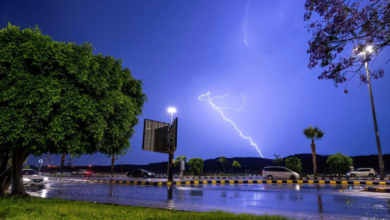
Weather forecast in Saudi Arabia: Thunderstorms and potential flash floods in 11 regions

Weather forecast in the Kingdom today
The National Center for Meteorology issued its daily weather forecast for Saudi Arabia, indicating continued weather fluctuations and varying intensities of thunderstorms across large parts of the country. According to the report, moderate to heavy rainfall, potentially leading to flash floods, is expected, accompanied by hail and strong winds in the regions of Najran, Jazan, Asir, Al-Baha, and Makkah. The chance of light to moderate rain also extends to parts of the Eastern Province, Riyadh, Qassim, Hail, Al-Jawf, and the Northern Borders region. This weather pattern will be accompanied by strong winds that will stir up dust and reduce horizontal visibility in parts of these regions, as well as in the Tabuk and Madinah regions.
The climatic context of weather fluctuations in Saudi Arabia
This wave of weather fluctuations is part of the Kingdom's typical spring weather patterns, known locally as the "Sarayat" or "Marawih" period. This period is characterized by the activity of low-pressure systems that cause atmospheric instability, leading to the rapid and sudden formation of cumulonimbus clouds. The Kingdom's topography plays a crucial role in determining rainfall intensity; the mountainous highlands in the southwest (such as the Sarawat Mountains in Asir and Al-Baha) contribute to lifting and condensing moist air, thus increasing the intensity of rainfall in those areas compared to the flat desert regions of the central and eastern parts of the country.
Expected effects and the importance of following warnings
These weather phenomena have direct impacts on daily life and infrastructure. Locally, relevant authorities, such as the General Directorate of Civil Defense, raise their alert levels and issue continuous warnings to citizens and residents, urging them to exercise caution and stay away from valleys and floodplains. Traffic on highways may also be affected due to reduced visibility or water accumulation. Despite the potential risks, these rains have positive aspects, contributing to groundwater replenishment, supporting the agricultural sector, and increasing vegetation cover, which has a positive impact on the environment. It is crucial to follow updates issued by the National Center of Meteorology and adhere to safety instructions to ensure everyone's well-being.
Sea conditions and surface winds
Regarding maritime navigation, the report indicated that surface winds on the Red Sea will be northwesterly to westerly at speeds ranging from 15 to 38 kilometers per hour, with wave heights between one and one and a half meters, resulting in a slight to moderate sea state. In the Arabian Gulf, surface winds will be northwesterly to northerly at speeds of 15-38 km/h, potentially exceeding 50 km/h with the formation of thunderstorms and rain. Wave heights are expected to range from half a meter to one and a half meters, and may exceed two meters with thunderstorms, resulting in a moderate sea state that may occasionally become rough.