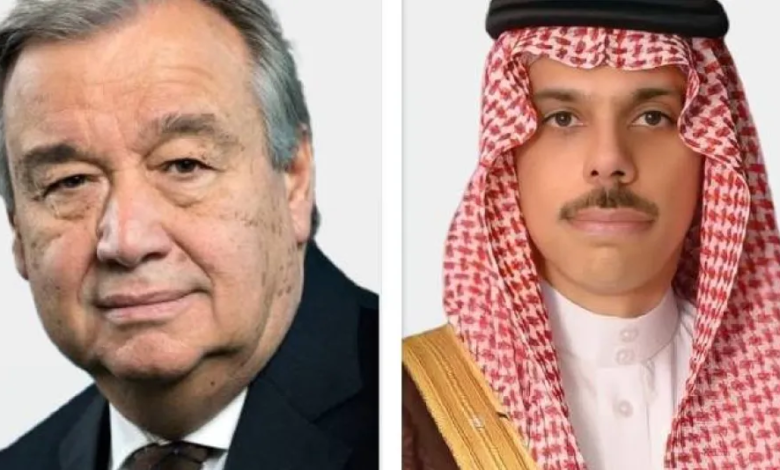

Introduction: A pivotal meeting to promote regional stability
As part of ongoing diplomatic efforts to promote security and stability in the Middle East, His Highness Prince Faisal bin Farhan bin Abdullah, the Saudi Minister of Foreign Affairs, discussed with His Excellency António Guterres, the Secretary-General of the United Nations, the most prominent developments in the region. This meeting comes at a highly sensitive time, as the region faces unprecedented political and humanitarian challenges that require high-level coordination between influential regional powers and international institutions to ensure the maintenance of international peace and security.
General context and historical background of regional crises
Historically, Saudi Arabia has played a leading role in supporting UN efforts to establish stability in the region. In light of the recent escalation in the occupied Palestinian territories, particularly the Gaza Strip, the urgent need to intensify diplomatic efforts has become even more apparent. Riyadh has consistently affirmed its unwavering support for the rights of the Palestinian people, calling for an immediate ceasefire and the unimpeded delivery of humanitarian aid, a stance that aligns with Guterres' repeated appeals to avert a full-blown humanitarian catastrophe.
In addition to the Palestinian issue, the regional context includes other complex crises such as the conflicts in Sudan and Yemen. The Kingdom, in cooperation with its international partners, hosted the Jeddah talks to bridge the gap between the Sudanese parties and led intensive efforts to support the UN-sponsored peace process in Yemen, making Saudi-UN coordination a cornerstone for any future political solutions.
The importance of the talks and their expected impact
Regional and local impact
Regionally, the talks between Prince Faisal bin Farhan and Guterres are of paramount importance in unifying visions on how to de-escalate tensions and prevent the conflict from spreading. Joint coordination contributes to activating the resolutions issued by Arab and Islamic summits, for which Saudi Arabia has played a leading role in formulating and monitoring their implementation. Domestically, this active diplomatic engagement reflects the Kingdom's commitment to Vision 2030, which identifies regional stability as a prerequisite for achieving economic development and prosperity for all the peoples of the region.
International influence
Internationally, the United Nations views Saudi Arabia as an indispensable strategic partner in the Middle East. The alignment between the two sides enhances the prospects for the success of UN initiatives, whether those related to providing humanitarian relief or resuming political processes. This meeting also sends a strong message to the international community about the need to uphold its legal and moral responsibilities regarding the ongoing violations of international humanitarian law, and to work diligently towards implementing the two-state solution as the only way to guarantee the long-term security and stability of the region.
Summary of joint efforts
In conclusion, the review of efforts between Prince Faisal bin Farhan and António Guterres represents a significant step in the path of multilateral diplomacy. The continuation of this close cooperation between the Kingdom of Saudi Arabia and the United Nations remains the strongest guarantee for addressing current challenges, alleviating human suffering, and laying solid foundations for a just and comprehensive peace that meets the aspirations of the region's peoples and preserves international peace and security.