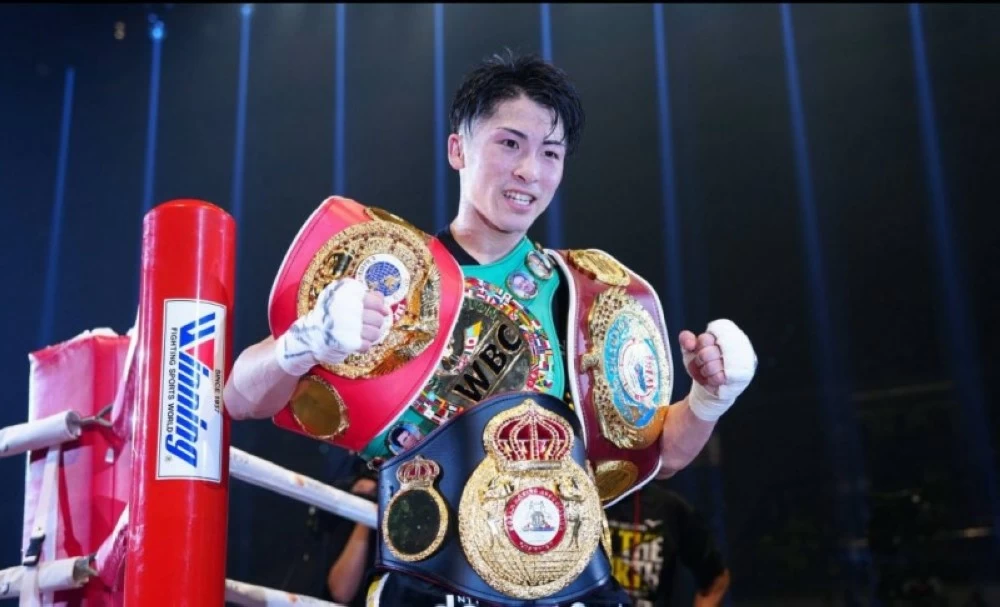
The eyes of the sports world are turning towards the Saudi capital, where the legendary Japanese boxer Naoya Inoue to participate in the “Samurai Night” fight, a highly anticipated event that comes as part of the Riyadh Season, reflecting the growing presence of the biggest international boxing stars on Saudi Arabian soil.
The "Beast's" Journey: Record-Breaking Numbers and Absolute Dominance
Nicknamed "The Japanese Beast," Inoue is a unique phenomenon in the world of modern boxing and one of the most prominent champions in the history of the sport. Not only did Inoue establish his dominance with a fighting style that combined devastating power, surgical precision, and lightning speed, but he also achieved historic feats, most notably unifying world titles in two different weight classes (bantamweight and super bantamweight), achieving a remarkable series of victories that cemented his status as one of the best pound-for-pound boxers in the world.
The Japanese champion is distinguished by his exceptional ability to decide fights early with knockouts, his intelligent reading of opponents’ movements from the first rounds, in addition to the strength of his physical punches that made him one of the most feared boxers in the lightweight division, making his participation in Riyadh a tremendous qualitative and technical addition to the boxing scene in the season.
Riyadh Season: The New Capital of World Boxing
Inoue's participation in the "Samurai Night" fight has garnered significant attention from boxing fans worldwide, given the event's symbolic significance, which blends the rich Japanese tradition of discipline and combat with the dazzling international flair that has come to characterize Riyadh Season's fights. This event follows a series of historic bouts recently hosted by the Kingdom, such as the "Ring of Fire" unification fight for the heavyweight titles, and other matches featuring legends of the sport, further solidifying Riyadh's position as a premier destination for combat sports globally.
Dimensions of the event and its international impact
The significance of "Samurai Night" extends beyond the purely sporting aspect, encompassing cultural and economic dimensions that align with the goals of Saudi Vision 2030 to bolster the entertainment and sports sectors and attract global tourism. Securing a star of Inoue's caliber, with his massive fan base in Asia and the United States, opens new horizons for Riyadh Season in Asian markets and underscores the Kingdom's ability to organize events that surpass those in Las Vegas and London.
As the date of the fight approaches, all eyes are on the arena where the "Japanese Beast" will appear, in a confrontation expected to be full of excitement and competitiveness, and confirming that Riyadh Season continues to fulfill its promises to provide exceptional sporting events that attract the most prominent stars of the game and are immortalized in the memory of the fans.