Imam Abdulrahman University honors 426 students who received professional certificates

In a move reflecting the qualitative shift in higher education outcomes in the Kingdom of Saudi Arabia, Imam Abdulrahman bin Faisal University the graduation of an exceptional class of 426 students who earned internationally accredited professional certifications. This achievement was celebrated during the inaugural annual meeting of the "Professional" initiative, in the presence of the university president, Professor Fahd bin Ahmed Al-Harbi, and the director of the Eastern Province branch of the Human Resources Development Fund (HRDF), Abdulaziz Al-Yousef.
Bridging the gap between education and the labor market
This event is not merely a routine academic celebration, but a practical response to the rapidly evolving demands of the job market. In today's highly competitive global and local economies, an academic degree alone is no longer sufficient to guarantee career excellence. The importance of professional certifications lies in their ability to give graduates a competitive edge, demonstrating their possession of precise, practical skills that go beyond theoretical knowledge. This aligns directly with the goals of the Kingdom's Vision 2030 and its Human Capital Development Program, which aims to cultivate a globally competitive citizenry.
The "Professional" Initiative: A Strategic Vision
This recognition came as a culmination of the efforts of the "Professional" initiative, launched on April 1, 2025, which the university designed to enhance the skills of its graduates. During the meeting, Dr. Al-Harbi emphasized that this initiative is a tangible manifestation of the university's commitment to developing a national workforce capable of leading future sectors. The meeting also included a panel discussion titled "From Student to Professional," where faculty members and graduates shared their experiences in leveraging these certifications to open up broad career opportunities and pathways for sustainable professional development.
Active partnership with "Hadaf" and financial support
On the sidelines of the celebration, the pivotal role of the Human Resources Development Fund (HRDF) was highlighted through a specialized workshop that reviewed the financial and logistical support mechanisms offered to students seeking professional certifications. This partnership between the academic sector and government support funds is a cornerstone for empowering Saudi youth, as the support helps overcome financial obstacles and encourages students to take international professional exams.
Numbers that reflect excellence
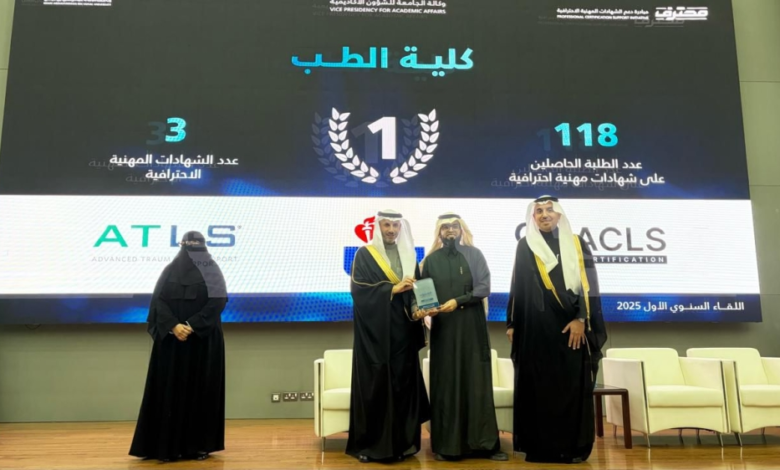
For his part, the university's Vice President for Academic Affairs, Dr. Abdullah Al-Muhaidib, explained that the initiative aims to instill a culture of "lifelong learning." In terms of statistics, Dr. Taghreed Al-Muqaitib, Director of the Assessment and Testing Quality Center, revealed remarkable figures: 37 students successfully obtained two to three professional certifications in record time, a strong indicator of the quality of the program's outcomes. Excellence awards were granted to all 426 students, and seven colleges that actively contributed to the initiative's success were recognized, underscoring the university's commitment to continuing to produce qualified national talent ready for immediate employment upon graduation.