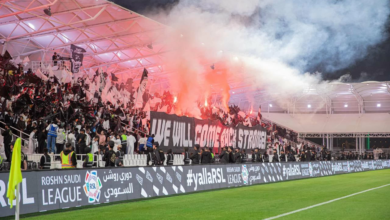

In a perfect start to his career with the Riyadh-based club, Spanish defender Pablo Mari, recently signed by Al-Hilal, expressed his immense happiness and pride at participating in the resounding victory achieved by "Al-Za'eem" (The Boss) over their arch-rivals Al-Nassr, by a score of 3-1. This epic match took place last night at the Kingdom Arena in Riyadh, as part of the top fixture of the 15th round of the Saudi Professional League.
The player didn't hide his feelings about the warm welcome and the strong start, tweeting on his official X account: "A new chapter begins. I'm grateful to play for the biggest club in Saudi Arabia, happy to have played my first match, and best of all, to start with a win." Mari continued by thanking everyone who supported him in this move, adding: "Thank you all for the warm welcome! And I'm always grateful to Arturo Canales and the entire AC Talent team for standing by me throughout my career." These words were met with widespread reaction and a warm welcome from Al-Hilal fans, who saw the player as a valuable addition to the defense.
The importance of the Riyadh derby and its impact on the title race
The matches between Al-Hilal and Al-Nassr hold historical and popular significance that transcends the mere fact of a three-point game. The Riyadh derby is considered the face of Saudi football and one of the fiercest derbies in the Arab world and Asia. This victory confirms Al-Hilal's technical dominance at this stage of the season, as the 3-1 win reflects the team's high level of readiness and its ability to decide major matches. This strengthens the fans' confidence in the team's ability to reclaim titles and compete strongly on all local and continental fronts.
In terms of the league standings, Al-Hilal strengthened their lead in the Roshan League with this valuable victory, raising their points tally to 38 and widening the gap with their closest pursuer, Al-Nassr, in second place, to a full 7 points. This relatively comfortable lead at the halfway point of the season gives Al-Hilal the flexibility to rotate players and focus on other competitions, while putting additional pressure on their rivals to catch up.
Details of the deal and its crucial timing
Al-Hilal's management announced the signing of Pablo Mari just 24 hours before the derby match, a swift move to bolster the team's ranks. According to sources, the player arrived from Italian club Fiorentina on a contract extending until the end of the current season, with an option to extend for an additional year. Press reports indicated that the transfer fee reached two million euros, including add-ons, reflecting the club's astute policy of acquiring players capable of making an immediate impact at a reasonable price.
Mari's joining comes at a time when Saudi stadiums are witnessing an unprecedented boom in attracting international stars, which has raised the level of competitiveness and made the Roshan League the focus of the world's attention, as being in clubs like Al-Hilal has become a golden opportunity for players to participate in an ambitious global sports project.