Saudi Arabia Weather: Statement of maximum temperatures in the Kingdom's cities

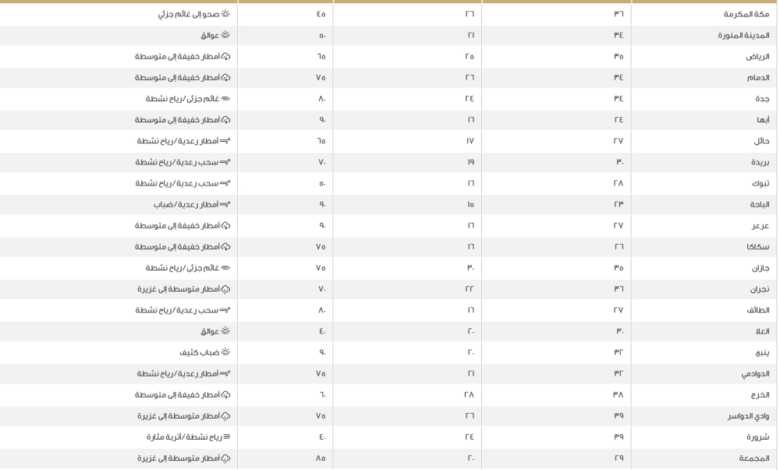
The National Center for Meteorology in Saudi Arabia issued its daily weather report, revealing a significant variation in maximum temperatures recorded on Wednesday across the Kingdom's cities and provinces. This variation reflects the diverse geographical and climatic characteristics of the country, with temperatures ranging from 17 degrees Celsius in the cooler mountainous regions to 39 degrees Celsius in some inland and desert areas.
Wadi Al-Dawasir and Sharurah recorded the highest temperatures at 39 degrees Celsius, followed by Al-Kharj and Al-Ahsa at 38 degrees, while Makkah recorded 36 degrees and the capital, Riyadh, 35 degrees. In contrast, the southern highlands enjoyed moderate weather, with As-Soudah recording only 17 degrees, Al-Baha 23 degrees, and Abha 24 degrees Celsius.
List of maximum temperatures in the cities of the Kingdom:
- Wadi Al-Dawasir: 39 degrees Celsius.
- Sharurah: 39 degrees Celsius.
- Al-Kharj: 38 degrees Celsius.
- Al-Ahsa: 38 degrees Celsius.
- Mecca: 36 degrees Celsius.
- Najran: 36 degrees Celsius.
- Riyadh: 35 degrees Celsius.
- Jazan: 35 degrees Celsius.
- Al Qunfudhah: 35 degrees Celsius.
- Al-Dahna desert: 35 degrees Celsius.
- Dammam: 34 degrees Celsius.
- Medina: 34 degrees Celsius.
- Jeddah: 34 degrees Celsius.
- Al-Saman: 34 degrees Celsius.
- Bisha: 33 degrees Celsius.
- Rawdat Al-Tanhat: 33 degrees Celsius.
- Al-Dawadmi: 32 degrees Celsius.
- Yanbu: 32 degrees Celsius.
- Hafar Al-Batin: 32 degrees Celsius.
- Buraidah: 30 degrees Celsius.
- Al-Ula: 30 degrees Celsius.
- Combined: 29 degrees Celsius.
- Tabuk: 28 degrees Celsius.
- Rafha: 28 degrees Celsius.
- Al Qurayyat: 28 degrees Celsius.
- Hail: 27 degrees Celsius.
- Arar: 27 degrees Celsius.
- Taif: 27 degrees Celsius.
- Face: 27 degrees Celsius.
- Sakaka: 26 degrees Celsius.
- Tarif: 25 degrees Celsius.
- Abha: 24 degrees Celsius.
- The courtyard: 23 degrees Celsius.
- Al-Sawda: 17 degrees Celsius.
The importance and impact of meteorological data
The reports issued by the National Center of Meteorology are of paramount importance, extending far beyond simply knowing the weather. Locally, residents rely on this data to plan their daily activities, choose appropriate clothing, and take necessary precautions against heatstroke or heat exhaustion, especially in areas experiencing high temperatures. This data also directly impacts vital sectors such as construction, where working hours are regulated to protect workers from the dangers of working in direct sunlight.
Climate diversity in Saudi Arabia
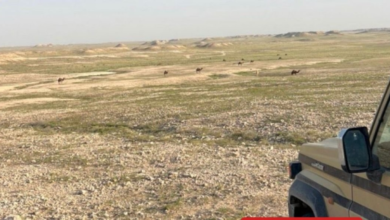
The temperature range clearly demonstrates the great climatic diversity of Saudi Arabia, which stems from its vast size and varied topography. While coastal areas on the Arabian Gulf and the Red Sea, such as Dammam and Jeddah, are characterized by high heat and humidity, central regions like Riyadh and Qassim have a dry, hot desert climate in the summer. In contrast, the Sarawat Mountains in the southwest, where cities like Abha and Al-Baha are located, offer a more temperate climate year-round thanks to their high altitude, making them major tourist destinations within the Kingdom.
Monitoring these daily climate changes not only serves individuals and institutions, but also contributes to building a deeper understanding of long-term climate patterns, which is vital for strategic planning in the fields of agriculture, water and energy, in line with the Kingdom’s Vision 2030 goals for achieving sustainable development.