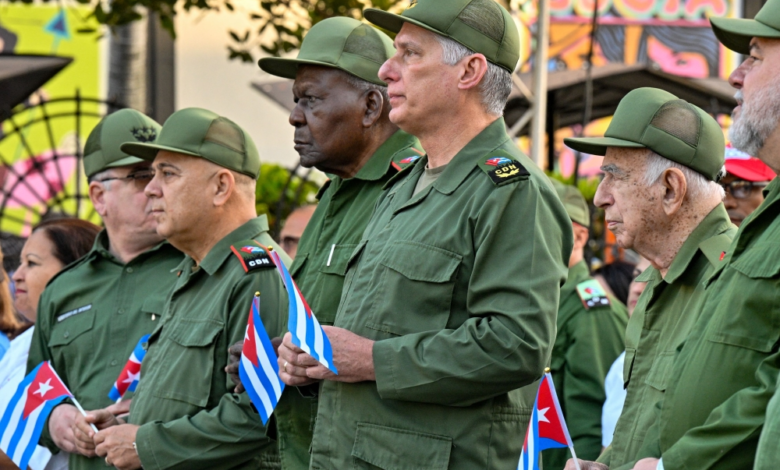

Cuban president warns of possible US attack
In remarks that have garnered widespread international attention, Cuban President Miguel Díaz-Canel announced that his country is placing its forces on high alert to counter a potential US attack. These statements come amid a marked escalation in political and economic pressure exerted by the US administration, particularly during the presidency of Donald Trump, aimed at tightening the noose around Havana and altering the course of the island's socialist system.
Historical background: Commemoration of the Bay of Pigs invasion
Díaz-Canel's remarks came before a massive crowd in Havana, commemorating the 65th anniversary of the failed Bay of Pigs invasion. The Cuban president affirmed that his country does not seek military confrontation, but is obligated to be fully prepared to avoid it, emphasizing that if war is imposed upon them, victory will be inevitable.
Historically, the Bay of Pigs invasion took place in mid-April 1961, when forces of Cuban exiles, with direct support and training from the US Central Intelligence Agency (CIA), attempted to overthrow the government of Fidel Castro. However, Cuban forces managed to repel the attack and inflict a crushing defeat on the invaders within a few days, marking a pivotal turning point in the Cold War and strengthening the regime on the island.
Reversing historic rapprochement and economic pressures
US-Cuban relations have been marked by fluctuations. Following the historic rapprochement led by former US President Barack Obama and his Cuban counterpart Raúl Castro in 2015, which resulted in the restoration of diplomatic relations, the Trump administration adopted a policy of “maximum pressure.” This policy included imposing harsh economic sanctions, a crippling oil embargo, and re-designating Cuba as a state sponsor of terrorism.
In this context, Mariela Castro, daughter of former President Raúl Castro, stated that the Cuban people welcome dialogue with Washington, but on the essential condition that the political system and national sovereignty remain untouched. She noted that her 94-year-old father had been indirectly involved in the recent détente talks, which made little progress.
Regional context: The alliance with Venezuela and Iran
These tensions take on greater significance given the regional and international context. Reports have linked the pressure on Cuba to that exerted on its strategic allies, specifically Venezuela and Iran. Havana is heavily reliant on Venezuelan oil imports, and the targeting of Venezuela's oil sector by US sanctions has exacerbated Cuba's economic crisis, making it the next target in Washington's regional strategy.
Resilience in the face of the siege
Cuba is currently suffering from a severe economic crisis characterized by shortages of fuel and basic goods, which the Cuban government directly attributes to the US embargo that has been in place for over six decades. Díaz-Canel vehemently rejected US attempts to portray Cuba as a “failed state,” asserting that it is a “blockaded country” paying the price for its adherence to its principles. This sentiment is echoed by Cuban citizens who have lived through past crises, affirming their complete readiness to defend their country’s sovereignty, whatever the cost.