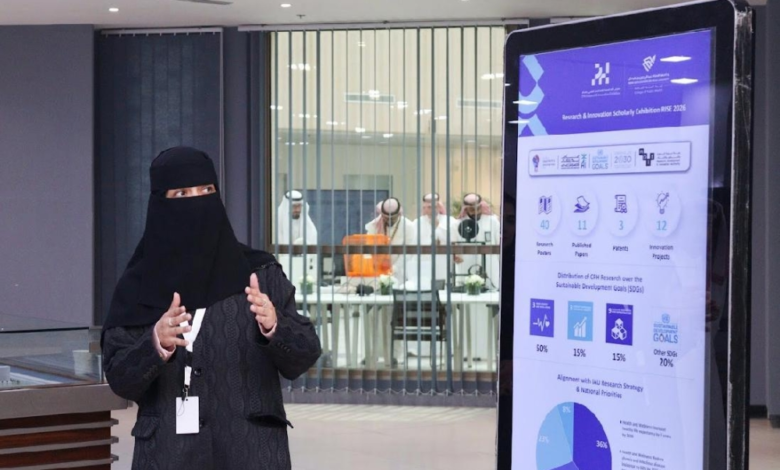

In a move reflecting its commitment to keeping pace with global technological advancements and harnessing them to serve the community, the College of Public Health at Imam Abdulrahman bin Faisal University organized a scientific exhibition showcasing 40 research papers and 13 innovative projects, all employing artificial intelligence technologies to develop the healthcare sector. This event, coinciding with World Innovation Day, served as an interactive platform that brought together researchers and students from various academic levels to connect theoretical knowledge with practical, field-based applications.
Integration with the Kingdom's Vision 2030
This initiative is not a coincidence; rather, it aligns directly with the strategic directions of the Kingdom of Saudi Arabia within Vision 2030, which places digital transformation and innovation at the heart of its objectives. The Kingdom is investing heavily in future technologies, particularly artificial intelligence, recognizing its pivotal role in building a knowledge-based economy and diversifying income sources. The Saudi Data & Artificial Intelligence Authority (SDAIA) is the driving force behind these efforts, working to develop and implement national strategies to solidify the Kingdom's position as a leader in this field. Initiatives such as the Imam Abdulrahman bin Faisal University exhibition translate this vision into tangible reality by developing national talent and fostering innovative solutions to address local challenges.
The importance of artificial intelligence in the health revolution
The global healthcare sector is undergoing a radical transformation thanks to artificial intelligence applications, which are no longer a luxury but a necessity for improving quality of life. These technologies contribute to the analysis of massive amounts of medical data with speed and accuracy exceeding human capabilities, aiding in the early diagnosis of diseases such as cancer and heart disease. They also open new horizons in the field of personalized medicine by designing customized treatment plans for each patient based on their genetic data and lifestyle. The projects showcased at the exhibition, which focused on developing healthcare services and enhancing preventative measures, are a testament to the university's understanding of this importance and its commitment to actively contributing to this healthcare revolution.
A platform for innovation and strategic partnerships
Dr. Duaa Al-Jabri, Vice Dean for Scientific Research and Innovation at the College of Public Health, explained that the exhibition reflects the university's strategic plan and supports the Sustainable Development Goals. She noted that the exhibition's outcomes align with the national priorities of the Research, Development, and Innovation Development Authority. To enhance the practical impact of this research, the university has been keen to build effective partnerships with prominent national entities, such as the Public Health Authority (Weqaya), the Aramco-supported Growth Center for Education, and the Innovation Oasis. This creates a stimulating environment for scientific dialogue, opens broad horizons for collaboration between the academic, health, and industrial sectors, and ensures the transformation of innovative ideas into products and services that benefit society.
Expected local and regional impact
Domestically, these innovations are expected to enhance the efficiency of the Saudi healthcare system, reduce costs, and improve the patient experience. Regionally, these efforts reinforce the Kingdom's position as a leading hub for health technology innovation in the Middle East, attracting investment and creative talent. Graduating a generation of researchers and innovators capable of utilizing and adapting artificial intelligence technologies to serve the healthcare sector is a long-term investment in the nation's future and underscores the pioneering role of Saudi academic institutions in achieving comprehensive and sustainable development.