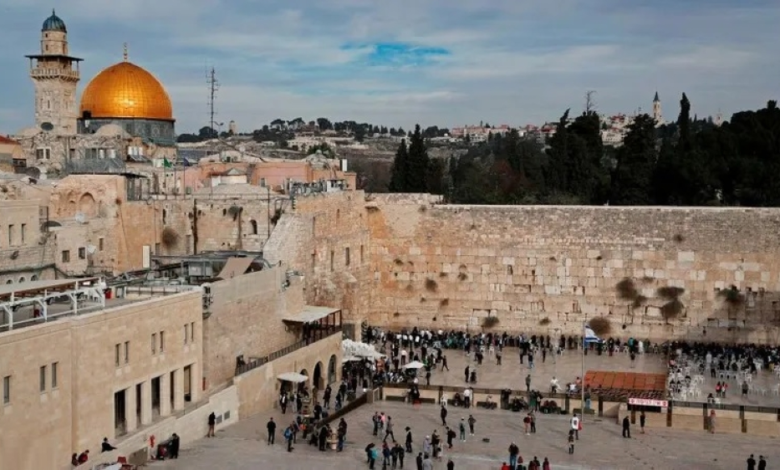
Arab and Islamic condemnation of Israeli violations in Jerusalem and Al-Aqsa

In a unified stance reflecting deep concern over developments in the occupied Palestinian territories, the foreign ministers of Saudi Arabia, Jordan, the United Arab Emirates, Qatar, Egypt, and Turkey, along with prominent Muslim-majority countries such as Indonesia and Pakistan, issued a joint statement strongly condemning Israel’s repeated violations in Jerusalem. The condemnation focused on practices aimed at altering the historical and legal status quo of Islamic and Christian holy sites, which constitute a provocation to the feelings of millions of Muslims worldwide.
Historical and legal background of the situation in Jerusalem
These condemnations come within the context of the complex historical and legal status of Jerusalem, whose eastern sector was occupied by Israel in 1967 in a move not recognized by the international community. Jerusalem and its holy sites, foremost among them the Al-Aqsa Mosque/Haram al-Sharif, are at the heart of the Israeli-Palestinian conflict. The historical status quo, administered by the Jordanian Islamic Waqf, regulates worship and visits to the Haram, where Muslims are permitted to pray freely, while visits by non-Muslims are restricted to specific times and prohibited from performing any religious rituals. The repeated incursions by settlers and extremist Israeli officials constitute a violation of this fragile status quo and a direct threat to it.
Details of the violations and their risks
The ministerial statement highlighted a series of provocative actions, most notably the ongoing incursions into the Al-Aqsa Mosque compound by settlers and extremist ministers under the protection of Israeli occupation forces, and the raising of the Israeli flag within the compound. The ministers affirmed that these actions constitute a flagrant violation of international law and international humanitarian law, and a blatant infringement upon the sanctity of the holy city. They also condemned the escalating settler violence against Palestinians in the occupied West Bank, including the recent attacks on schools and children, and demanded that those responsible for these crimes be held accountable.
Regional and international repercussions
The continuation of these violations not only fuels tensions locally but also threatens to destabilize the entire region. Jordan, under the historic Hashemite custodianship of the holy sites, considers any alteration of the status quo a direct challenge to its role and responsibilities. These events also place pressure on Arab states that maintain diplomatic relations with Israel. Internationally, these unilateral actions undermine peace efforts, erode the foundations of the internationally agreed-upon two-state solution, and obstruct initiatives aimed at de-escalation and rebuilding trust between the parties.
A firm Arab and Islamic stance
The ministers reiterated their categorical rejection of any attempts to alter the historical and legal status quo in Jerusalem and its holy sites. They reaffirmed that the entire 144-dunum area of the Al-Aqsa Mosque compound is a place of worship exclusively for Muslims, and that the Jordanian Jerusalem Waqf and Al-Aqsa Mosque Affairs Department is the sole legal authority with exclusive jurisdiction over the management of the compound. The ministers also called upon the international community to uphold its legal and moral responsibilities, compel Israel to cease its dangerous escalation, and intensify efforts to advance a political solution that achieves a comprehensive and just peace based on the two-state solution, guaranteeing the establishment of an independent Palestinian state within the June 4, 1967 borders, with East Jerusalem as its capital.