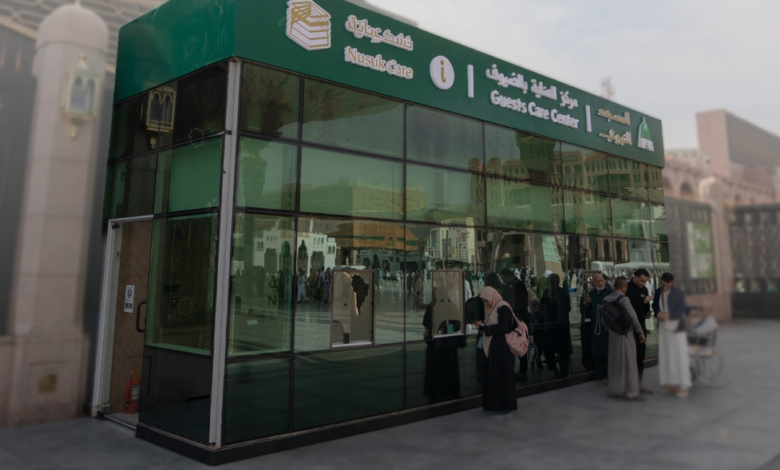
Guest service centers at the Prophet's Mosque: Comprehensive services and their locations

As part of ongoing efforts to enhance services for visitors to the Two Holy Mosques, the General Authority for the Care of the Grand Mosque and the Prophet's Mosque continues to dedicate all its resources to serving worshippers. The "Guest Service Centers" at the Prophet's Mosque are among the most prominent initiatives aimed at providing a convenient and safe spiritual experience for pilgrims, in line with the objectives of the Kingdom's Vision 2030 and the Guests of God Service Program.
Comprehensive care and high-quality services
The guest service centers act as a direct link between the Authority and visitors, offering a wide range of field and digital services that cover all visitor needs from the moment they arrive at the Prophet's Mosque. The Authority clarified through its official platforms that these centers are not limited to providing spatial guidance, but extend to offering advanced human and technological care.
Among the most prominent services offered by these centers is the provision of safety bracelets for children and the elderly. This is an important preventative measure that facilitates quick reunification with their families if they become lost in crowds, thus enhancing peace of mind for families. The centers also provide specialized services for lost individuals , assisting them in finding doors and various facilities.
Digital transformation and support for people with disabilities
In keeping with technological advancements, the centers provide visitors with the necessary technical support for using smart government applications such as "Nusk" and "Tawakkalna," making it easier for them to book appointments at the Prophet's Mosque and access other digital services. In a humanitarian gesture reflecting the values of solidarity, the centers offer a cart loan for the elderly and people with disabilities, specifically at the two centers located at Gates 301 and 331, ensuring their ease of movement and facilitating their performance of religious rites.
Religious guidance and global communication
Given the great cultural and linguistic diversity of visitors to the Prophet's Mosque, the centers offer communication , breaking down language barriers and ensuring that every visitor receives accurate information. In addition, they provide religious guidance to answer questions on Islamic law and first aid services to address any medical emergencies.
Center locations and opening hours
To ensure easy access, the centers have been strategically distributed in the main areas of the Prophet's Mosque, and they operate 24 hours a day to serve visitors at any time:
- North side: Covers doors (329, 331, 339), noting that the service is available 24 hours a day.
- South side: Covers doors (301, 307), where the 301 door center operates 24 hours a day.
These efforts come as a confirmation of the leading role of the Kingdom of Saudi Arabia in serving the Two Holy Mosques, and its constant keenness to provide the utmost comfort and tranquility for worshippers and visitors from all over the world.