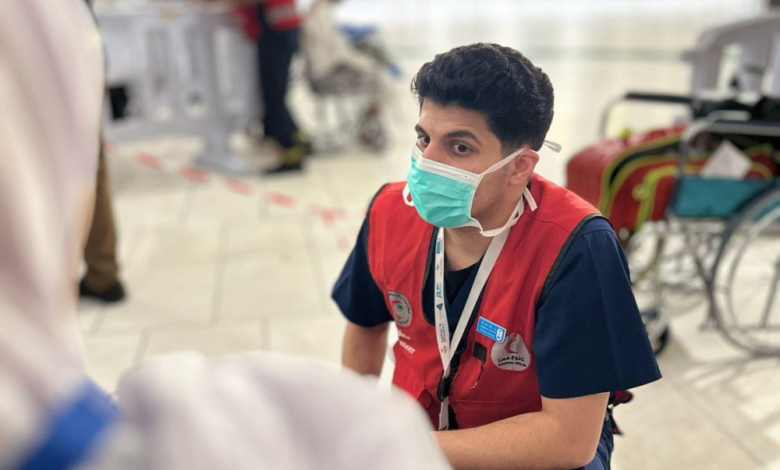

The Saudi Red Crescent Authority in Madinah announced the launch of its comprehensive operational plan for the 1445 AH Hajj season, as part of the Kingdom of Saudi Arabia's extensive preparations to ensure the safety and comfort of pilgrims. This comprehensive plan aims to provide the highest levels of emergency medical care to pilgrims, both within the Prophet's Mosque and on the roads leading to and from Madinah.
Historical background and importance of ambulance services during Hajj
Since its founding, the Kingdom of Saudi Arabia has placed paramount importance on serving pilgrims performing Hajj and Umrah, considering it both an honor and a great responsibility. With the increasing number of pilgrims annually, thanks to advancements in transportation and the massive expansion projects at the Two Holy Mosques, the need for a sophisticated healthcare and emergency response system capable of handling any emergency has become increasingly apparent. The Saudi Red Crescent Authority plays a pivotal role in this system, possessing extensive historical experience in crowd management and providing medical services under the most challenging circumstances. This year's plan builds upon a legacy of continuous development, drawing on past lessons and integrating the latest technologies to enhance response efficiency.
Details of the operational plan for the year 1445 AH
The Director of the Authority's branch in the Madinah region, Ahmed bin Ali Al-Zahrani, explained that the plan will be implemented starting at the beginning of Dhu al-Qi'dah and will continue until the 15th of Muharram, 1446 AH, thus covering all stages of pilgrims' arrival in Madinah before Hajj and their departure after completing their rituals. The plan includes the operation of 10 operational sectors, supported by an operational force of more than 90 advanced ambulance units. This force includes 54 ambulances and 27 diverse rapid intervention teams equipped with motorcycles, bicycles, scooters, golf carts, and electric "Rufaidah" vehicles, which are specifically designed for ease of movement within crowded areas and the courtyards surrounding the Prophet's Mosque.
Advanced equipment and qualified personnel
To ensure effective handling of various cases, all ambulance units are equipped with the latest medical equipment and technologies. The plan also includes specialized response vehicles dedicated to disasters and multi-casualty incidents, in addition to the full readiness of the air ambulance service for the urgent transport of critical cases. More than 700 paramedics, technicians, and administrative staff are involved in implementing this plan, working within an integrated system to guarantee rapid response and high-quality performance. They are supported by approximately 1,200 volunteers who have been trained in the necessary first aid skills and will be deployed to critical locations to provide immediate support.
Technology in service of the pilgrims
The regional medical dispatch center plays a vital role in managing operations, receiving calls around the clock via the emergency number (997) and the “Is’afni” (Help Me) app. These calls are electronically routed to the nearest ambulance crew through the “Electronic Paramedic” system, which allows for tracking the crews’ movements in the field to ensure their arrival as quickly as possible. Furthermore, healthcare facilities are provided with comprehensive electronic ambulance reports on the patient’s condition before arrival, contributing to the preparedness of hospital medical teams and enhancing the efficiency of healthcare services.
Importance and expected impact of the plan
The importance of this plan extends beyond the local level to the international level. Locally, it ensures the health and safety of millions of visitors and alleviates pressure on the healthcare system. Internationally, these efforts reflect the Kingdom's commitment to its responsibilities as a leader of the Islamic world and custodian of the Two Holy Mosques, reinforcing the confidence of Muslim countries in Saudi Arabia's ability to organize the Hajj season successfully and safely. These preparations also contribute to presenting a positive and progressive image of the Kingdom, underscoring its dedication to utilizing all its resources to serve Islam and Muslims, in line with the goals of Vision 2030.