
Introduction: A Saudi environmental achievement that has garnered global acclaim
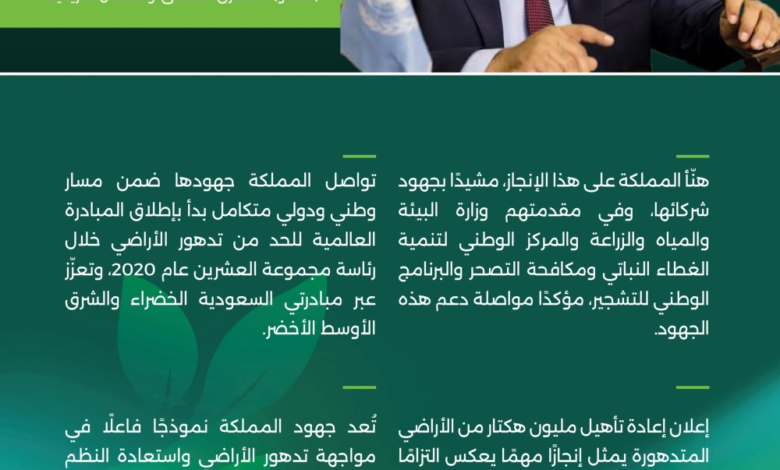
In a move reflecting the Kingdom of Saudi Arabia’s unwavering commitment to environmental protection and combating climate change, the Food and Agriculture Organization of the United Nations (FAO) commended the Kingdom’s official announcement of its success in rehabilitating one million hectares of degraded land. This exceptional achievement, undertaken within the framework of the “Saudi Green Initiative,” underscores the ongoing support provided by the Saudi leadership to address the degradation of ecosystems. These efforts are further solidified through an effective strategic partnership with the National Afforestation Program, reflecting the Kingdom’s seriousness in achieving the Sustainable Development Goals.
Historical context: Vision 2030 and the Saudi Green Initiative
To understand the magnitude of this achievement, it is necessary to consider the broader context and historical background of Saudi Arabia’s environmental efforts. Since the launch of Vision 2030, Saudi Arabia has placed environmental protection at the heart of its development strategies. In 2021, His Royal Highness Crown Prince Mohammed bin Salman launched the “Green Saudi Arabia” initiative, which aims to plant 10 billion trees within the Kingdom and rehabilitate 40 million hectares of land, contributing to reducing carbon emissions and combating desertification. This approach is not a recent development, but rather an extension of the Kingdom’s efforts during its presidency of the G20 in 2020, where it spearheaded a global initiative to reduce land degradation and preserve coral reefs, laying the groundwork for collaborative international environmental action.
The importance of the event: Turning visions into tangible reality
The FAO Regional Representative for the Near East and North Africa, Dr. Abdelhakim Elouaer, explained that this significant environmental achievement reflects the Kingdom's practical commitment to translating ambitious national visions into tangible and measurable results on the ground. Dr. Elouaer congratulated FAO's local partners, foremost among them the Ministry of Environment, Water and Agriculture, the National Center for Vegetation Development and Combating Desertification, and the National Afforestation Program, on reaching this remarkable environmental milestone. Restoring one million hectares means revitalizing entire ecosystems, improving air quality, and enhancing biodiversity, all of which positively impact the quality of life for citizens and residents.
Expected impact: A leading regional and international model
The impact of this achievement extends beyond the local level to encompass regional and international dimensions. Regionally, the Kingdom is leading the “Green Middle East” initiative, which aims to plant 50 billion trees in the region, representing the world’s largest reforestation program. Internationally, these efforts contribute to supporting the United Nations Sustainable Development Goals, particularly Goal 15, which focuses on protecting life on land.
Conclusion: The sustainability of natural resources for future generations
Dr. Al-Waer concluded his remarks by emphasizing that the Kingdom is steadily progressing on its integrated path, noting that strengthening this path through the "Saudi Green" and "Green Middle East" initiatives has made Saudi Arabia a leading and influential global model in the sustainability of natural resources. This international recognition is but a culmination of ongoing efforts that demonstrate the Kingdom of Saudi Arabia's pivotal role in shaping a greener and more sustainable environmental future for the entire world.