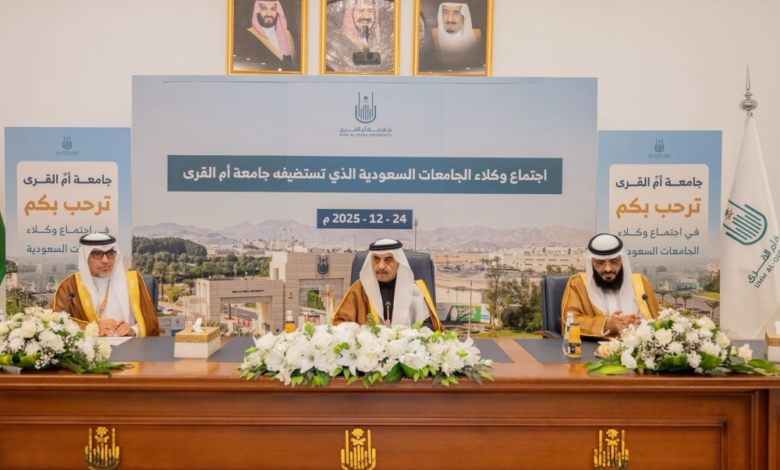
Umm Al-Qura University hosts a meeting of Saudi university vice-chancellors

In a move aimed at unifying efforts and strengthening institutional work in the higher education sector, the President of Umm Al-Qura University, Professor Dr. Maadi bin Mohammed Al-Mathhab, inaugurated the meeting of Saudi university vice-rectors for administrative and financial affairs. The meeting was held in the King Faisal Hall at the university campus in Al-Abdiyyah, with a distinguished attendance of leading administrative figures from Saudi universities, to discuss ways to develop the administrative and financial system.
The context of transformation in Saudi universities
This meeting comes at a crucial time, as the higher education sector in Saudi Arabia undergoes radical transformations, in line with the new university system that grants universities controlled autonomy and drives them towards financial sustainability. Such meetings are of paramount importance as they serve as a platform for exchanging expertise on effective resource management and transitioning from traditional management styles to more flexible and efficient operational models that support the national drive towards privatization and partnerships with the private sector.
Meeting topics: Governance and spending efficiency
The participants discussed a range of strategic issues, foremost among them the governance of the administrative and legal system, and reviewed successful experiences in operational contracts for projects. Emphasis was also placed on operational, maintenance, and infrastructure practices, which are fundamental pillars for ensuring a sustainable learning environment.
In his welcoming remarks, the President of Umm Al-Qura University emphasized the importance of this gathering in strengthening integration among universities, noting that the exchange of administrative expertise is the best way to overcome current challenges. For his part, the University's Vice President, Professor Dr. Farid Al-Ghamdi, explained that the meeting serves as a strategic platform for discussing topics that directly impact the efficiency of institutional work, such as:
- Improving spending efficiency and maximizing the use of available financial resources.
- Setting priorities in line with the objectives of Saudi Vision 2030.
- Technological transformation and enhancing the security of university campuses.
- Improving the quality of life on campus.
- Strategic workforce planning.
A tour of the Makkah Valley: The knowledge economy in reality
On the sidelines of the meeting, the university organized a program for the visiting delegation, which included a tour of Wadi Makkah Technology Company, the investment arm of Umm Al-Qura University. This company serves as a prime example of universities' focus on the knowledge economy and the transformation of innovations into economically valuable products. The university representatives also visited the university's cultural center, where they viewed a rare collection of archaeological and historical artifacts, coins, and manuscripts, reflecting the rich historical and cultural heritage of Makkah and the university's role as a beacon of science and knowledge.