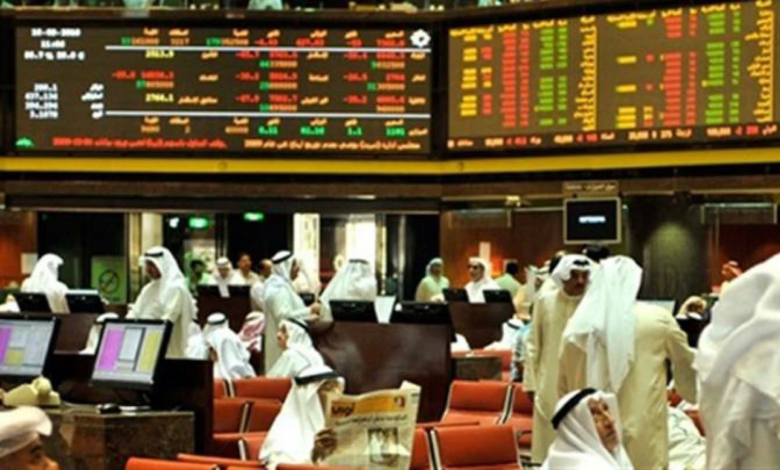

A wave of widespread declines swept across Gulf stock markets at the close of trading today, as escalating geopolitical tensions cast a heavy shadow over investor sentiment. This downturn followed renewed fears of a military escalation in the region, including tit-for-tat attacks between Iran and the United States, raising widespread concerns about the region's fragile stability and triggering heavy selling in major stock exchanges.
Performance of Gulf stock market indices:
In terms of performance, the Dubai Financial Market's main index led the declines, falling 0.9%, heavily impacted by the drop in leading stocks in the aviation and banking sectors. Air Arabia's shares fell 3.6%, while Mashreq Bank's shares declined 5%. In the UAE capital, the Abu Dhabi Securities Exchange index closed down 0.3%, pressured by a 0.3% decline in Aldar Properties' shares.
The Saudi market, the largest in the region, was not immune to these pressures, with its benchmark Tadawul All Share Index (TASI) declining by 0.8%. The Qatar Stock Exchange index also fell by 0.6%, with Qatar Islamic Bank shares dropping by 1.1%. The declines extended to the Bahrain, Kuwait, and Oman stock exchanges, whose indices fell by 1.2%, 0.3%, and 0.1%, respectively.
General context and its economic impact:
Historically, Gulf financial markets have shown extreme sensitivity to geopolitical risks due to the region's strategic importance as a global energy hub and a vital corridor for international trade. Any threat to stability, particularly in key shipping lanes such as the Strait of Hormuz, raises concerns about disruptions to oil supplies and trade, prompting local and foreign investors to liquidate their assets and seek safe havens.
These developments come at a critical time as Gulf states seek to diversify their economies away from oil. A recent survey showed that non-oil private sector growth in the UAE slowed to its lowest pace since February 2021, with tensions negatively impacting vital sectors such as shipping and tourism, thus affecting sales and exports. This underscores that the repercussions of instability extend beyond financial markets, impacting the long-term economic objectives of countries in the region.
Importance and expected effects:
Regionally, this collective decline is wiping billions off the market capitalization of listed companies and increasing uncertainty, which could delay investment and expansion decisions. Internationally, any continued escalation in the Gulf region threatens the stability of global energy markets and could lead to higher oil prices, fueling inflationary pressures worldwide. Outside the Gulf, reflecting the divergent performance of regional markets, Egypt's blue-chip index rose by 1.1%, supported by a 2.3% increase in Commercial International Bank shares, suggesting that investors may be differentiating between markets based on their specific local factors.