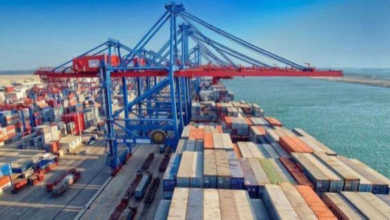
Strengthening the Saudi logistics sector: Successful government initiatives

Federation of Saudi Chambers: Public-private partnerships successfully address logistical challenges
The Federation of Saudi Chambers announced significant achievements in the logistics sector, thanks to collaborative efforts between the public and private sectors. In this context, the Federation's Chairman, Abdullah Saleh Kamel, stated that recent government initiatives have directly contributed to enhancing the sector's efficiency, providing 13 alternative shipping services with a capacity exceeding 97,000 containers. These statements follow the launch of the "Logistics Challenges Observatory," which successfully identified more than 130 challenges facing vital sectors. Twenty-two of these challenges have already been analyzed and addressed in coordination with relevant authorities, while work is underway to resolve the remaining challenges.
Kamel emphasized that these joint efforts maintained the smooth flow of trade and demonstrated remarkable resilience in the face of global disruptions. Government incentives included storage exemptions of up to 60 days, the implementation of a pre-clearance system that reduced clearance times to less than 24 hours, and the expanded adoption of digital solutions to enhance operational efficiency.
Vision 2030: The strategic framework for transforming the Kingdom into a global logistics hub
These developments are not happening in a vacuum; rather, they are an integral part of the National Transport and Logistics Strategy, stemming from Saudi Vision 2030. This ambitious vision aims to diversify the national economy and reduce dependence on oil by developing promising economic sectors, foremost among them the logistics sector. Through this strategy, the Kingdom seeks to leverage its unique geographical location, connecting Asia, Europe, and Africa, to transform itself into a major global logistics hub and a pivotal point in international trade.
Economic importance and expected impacts at the local, regional, and international levels
The development of the logistics sector in Saudi Arabia is of paramount strategic importance. Domestically, this development contributes to the creation of thousands of jobs, enhances the efficiency of supply chains for local companies, and reduces import and export costs, ultimately benefiting the end consumer. Regionally, these efforts reinforce the Kingdom's position as a leading trade hub in the Middle East, providing alternative and stable trade routes amidst geopolitical tensions affecting traditional shipping lanes. Internationally, Saudi Arabia's advanced logistics infrastructure contributes to the increased resilience and stability of global supply chains and attracts further foreign direct investment seeking a stable and efficient business environment.
Advanced infrastructure and promising future ambitions
Professor Abdullah Kamel noted that the private sector continues to perform at a high level of efficiency, relying on an advanced logistics infrastructure that includes more than 10 commercial ports and a multimodal transport network. National companies have demonstrated their readiness by diversifying shipping routes and utilizing alternative corridors. The Kingdom aims to achieve ambitious goals by 2030, including increasing port capacity to more than 20 million containers annually and establishing 59 integrated logistics zones, thus confirming its determination to solidify its position as a key player on the global trade map.