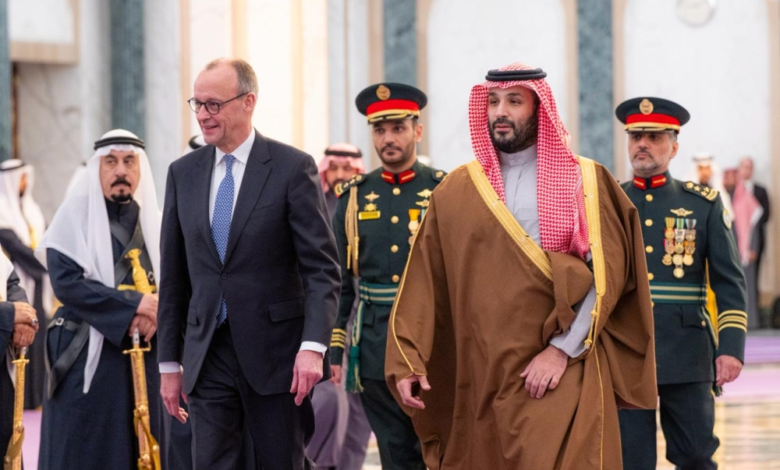

In a high-level diplomatic event reflecting the depth of bilateral relations between the two countries, His Royal Highness the Crown Prince received the Federal Chancellor of the Federal Republic of Germany, where they held an expanded official session of talks that addressed ways to enhance joint cooperation in various fields, in addition to discussing the most prominent developments on the regional and international arenas.
Details of the official talks session
During the meeting, Saudi-German relations were reviewed, along with promising opportunities for their development in a way that serves the common interests of the two friendly nations. Discussions focused on the importance of strengthening economic and investment partnerships, particularly in light of the major economic transformations underway in the Kingdom as part of Vision 2030, many of whose objectives align with Germany's long-standing expertise in industry, technology, and renewable energy.
Economic context and the future of energy
This visit comes at a crucial time, as the world undergoes major transformations in the energy sector. Saudi Arabia and Germany are key players in the G20, with the Kingdom wielding significant influence in stabilizing global energy markets, while Germany is Europe's largest industrial power. Clean energy and green hydrogen are therefore of paramount importance to both countries, as Berlin seeks to diversify its energy sources and Riyadh strives to become the world's leading producer of clean hydrogen, thus creating a solid foundation for a long-term strategic partnership.
Political importance and regional role
On the political front, this meeting is of paramount importance given the pivotal role both countries play in their regional and international environments. Discussions focused on exchanging views regarding current issues in the Middle East, ways to enhance security and stability, and combating terrorism. Germany views the Kingdom as an essential and indispensable partner in resolving regional crises and ensuring the region's stability, given the Kingdom's political and spiritual standing.
A history of joint cooperation
It is worth noting that Saudi-German relations span decades, characterized by mutual respect and constructive cooperation. The Saudi-German Joint Committee continuously works to remove obstacles facing the private sector in both countries in order to increase the volume of trade. This meeting adds another building block to these relations, underscoring the political will of both countries' leadership to propel this partnership towards broader horizons, contributing to achieving sustainable development and global economic prosperity.