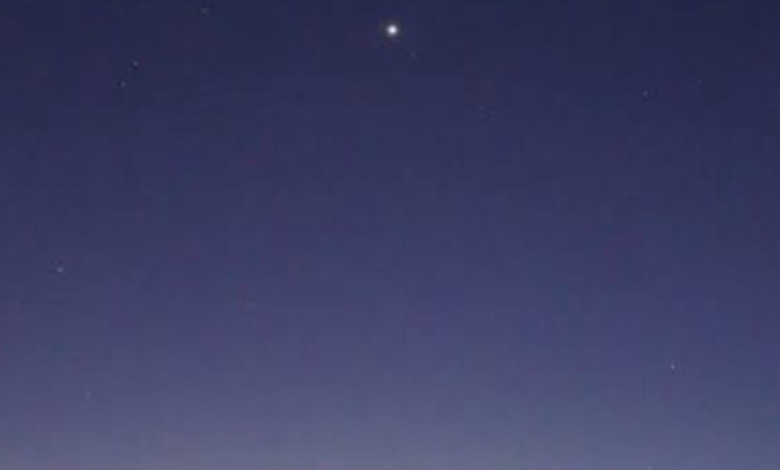
Mercury observed at its greatest elongation at dawn on Saturday | Jeddah Astronomy

A golden opportunity for astronomy enthusiasts to observe the planet Mercury
The Jeddah Astronomical Society revealed a remarkable astronomical event awaited by astronomy enthusiasts and skywatchers, as the planet Mercury will reach its greatest western elongation (morning elongation) at dawn on Saturday, April 4, 2026. This phenomenon is considered a golden and rare opportunity to observe the smallest planet in the solar system, as it will be angularly separated from the sun by a distance of about 28 degrees, allowing it to be clearly seen above the eastern horizon just before sunrise.
Monitoring details and best times for monitoring
The head of the Jeddah Astronomical Society, Engineer Majed Abu Zahra, explained that Mercury will appear at this time as a relatively bright point of light in the sky. Observers can easily see it with the naked eye, provided the sky is clear and cloudless. He noted that using binoculars will greatly improve visibility, especially in areas with light pollution or dust near the horizon. The planet will reach its highest point, approximately 17 degrees above the horizon, just before sunrise, before gradually fading as daylight increases.
Scientific context: Why is Mercury usually difficult to observe?
Scientifically, Mercury is the closest planet to the Sun, orbiting in an inner orbit between the Earth and the Sun. This strategic location means it is always close to the Sun's glare in Earth's sky, making it difficult to observe on ordinary days. Because its orbit is remarkably elliptical, its greatest elongation (its maximum angular distance from the Sun as seen from Earth) typically ranges between 18 and 28 degrees. This variation makes certain periods of elongation, particularly during spring in the Northern Hemisphere, more suitable for visual observation than other times of the year.
The historical significance of Mercury's motion in modern physics
Historically, precise measurements of Mercury's motion have played a pivotal role in shaping modern physics. In the 19th century, astronomers observed slight deviations in Mercury's orbit (known as perihelion precession) that Isaac Newton's laws of gravity could not fully explain. This puzzle remained unsolved until Albert Einstein's theory of general relativity in the early 20th century, which provided a precise explanation for the immense gravitational pull of the Sun on the curvature of spacetime around Mercury. This made the observation of this planet a cornerstone in proving one of the most important scientific theories in history.
The impact of the phenomenon locally and regionally, and space missions
At the local and regional levels, the skies of Saudi Arabia and the Arab region in general enjoy exceptional clarity in many desert and mountainous areas, making them ideal for observing such astronomical phenomena. Astronomical societies play a vital role in leveraging these events to disseminate scientific awareness and educate the public. While ground-based observation is limited to tracking Mercury's position, brightness, and phases, which resemble those of the Moon, international space agencies have launched specialized missions such as Mariner 10, MESSENGER, and, more recently, the joint European-Japanese space agency BepiColombo mission, to gather detailed data about the planet's surface and thin atmosphere. This astronomical phenomenon underscores the importance of continued ground-based observations that complement space-based data to refine orbital models and gain a deeper understanding of our solar system's environment.