Venus, Uranus, and Pleiades Conjunction 2026: The Complete Observation Guide

A unique astronomical event brings together three celestial bodies
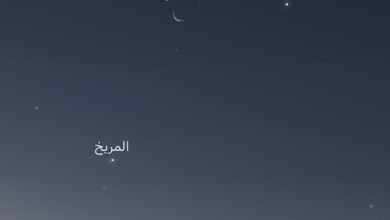
The Jeddah Astronomical Society announced a remarkable astronomical phenomenon that will grace the skies of the region on the evening of Thursday, April 23, 2026. A rare celestial conjunction will occur, bringing together the exceptionally bright planet Venus, the fainter planet Uranus, and the famous Pleiades star cluster. The Society's president, Engineer Majid Abu Zahra, explained that this alignment will create a stunning celestial display within the constellation Taurus, offering observers the opportunity to witness celestial bodies that vary greatly in their nature, brightness, and distance from Earth, all in a single spectacle.
General context: What is an astronomical conjunction?
A conjunction is an optical illusion that occurs when two or more celestial bodies appear close together in the sky from our perspective on Earth. This apparent closeness is merely an optical illusion, as the actual distances between these objects in space are vast. In this event, Venus, our nearest neighbor, will be only millions of kilometers away, while Uranus will be billions of kilometers away, and the Pleiades star cluster will be approximately 440 light-years away. This enormous variation in distance makes the event an educational opportunity to understand the scale of the universe.
The heroes of the celestial scene and their importance
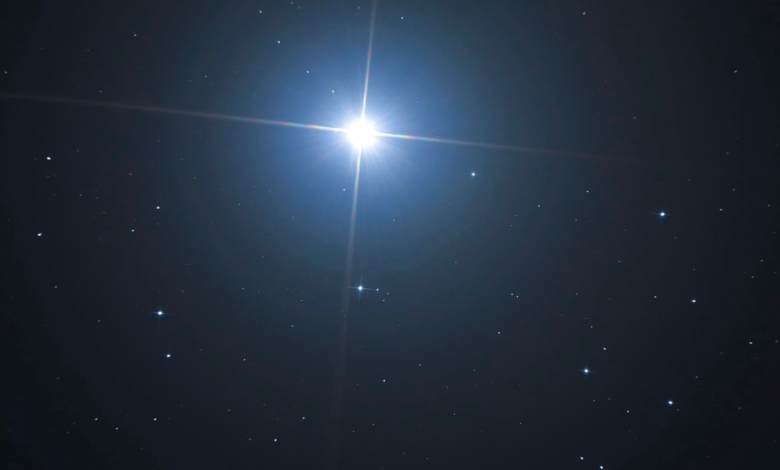
This conjunction brings together three of the most famous celestial objects. Venus, known as the "Evening Star" or "Morning Star," is the brightest planet in Earth's sky and the second planet from the Sun, easily visible to the naked eye. Uranus, the seventh ice giant in our solar system, is so faint that it wasn't discovered until 1781 by William Herschel, and observing it requires binoculars or a telescope. Finally, there's the Pleiades star cluster (M45), also known as the "Seven Sisters," a young and captivating star cluster with a special place in the history of civilizations. It's mentioned in Greek mythology and played a significant role in determining the seasons for the ancient Arabs.
How to observe the phenomenon and the best times
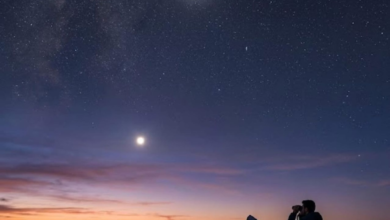
According to astronomical calculations, the best time to view this conjunction will be approximately 75 to 90 minutes after sunset, looking towards the western horizon to the northwest. The celestial gathering will be relatively low, between 10 and 15 degrees above the horizon. Therefore, it is advisable to choose an observation location with an open horizon, free from obstructions such as buildings or mountains. Venus will be the main attraction in the sky due to its brilliance, and with binoculars, the observer will be able to locate Uranus, which will appear as a faint point of light nearby, as well as view the Pleiades star cluster more clearly.
Scientific importance and expected impact
This event presents a valuable opportunity for amateur astronomers and astrophotographers, both locally and internationally, to document this rare alignment. It also provides rich educational material for the general public and students to understand planetary motion and orbits. Observing a nearby, bright planet, a distant, faint planet, and an exoplanetary star cluster all within the same field of view highlights the incredible diversity of celestial bodies in our galaxy and fosters greater awareness of astronomy. Astronomical observatories and news agencies worldwide are expected to share images and reports of this event, showcasing the beauty of the universe and encouraging interest in science.