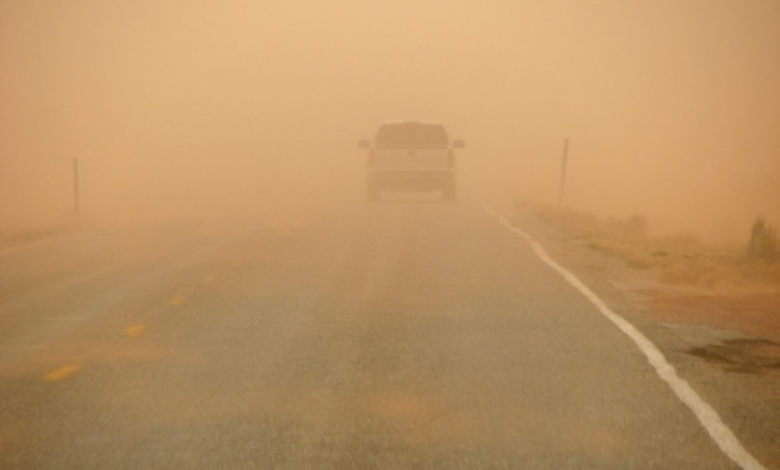

The Regional Center for Dust Storms announced in its daily report that it had recorded 73 dust storms in the Middle East region over the past 24 hours, reflecting the continued weather fluctuations affecting several countries in the region. The report indicated that Saudi Arabia topped the list of most affected countries with 31 dust storms, followed by Jordan with 23, and Pakistan with 10. Four storms were recorded in Egypt, and two each in Iraq and Iran, while the remaining countries in the region did not record any storms during the monitoring period.
Historical and geographical context of the dust storm phenomenon
Dust and sandstorms are a recurring natural phenomenon in the Middle East and North Africa region, which lies within the so-called "dust belt" extending from the coasts of West Africa across the Sahara and the Middle East to Central Asia. These storms arise from several natural factors, most notably strong, dry winds blowing across the arid and loose desert soil, such as the seasonal northerly winds. However, recent studies indicate that the frequency and intensity of these storms have increased in recent decades due to human factors and climate change, such as desertification, vegetation degradation, and drought resulting from unsustainable management of water and land resources.
Expected impacts at the local and regional levels
Dust storms have far more than just reduced visibility; they have widespread repercussions for public health, the economy, and the environment. From a health perspective, inhaling fine particulate matter in the air exacerbates respiratory conditions such as asthma and allergies, and causes eye and skin irritation, posing a significant risk to children, the elderly, and those with chronic illnesses. Economically, these storms paralyze air and land transportation and negatively impact vital sectors like agriculture, where dust covers crops and erodes soil, in addition to reducing the efficiency of solar power plants, on which the region increasingly relies.
Regional efforts to confront and adapt
Recognizing the scale of the challenge, efforts are intensifying at both the national and regional levels to combat dust storms and mitigate their effects. The Regional Center for Early Warning of Sand and Dust Storms, hosted by Riyadh, plays a key role in these efforts, monitoring weather phenomena, analyzing data, and issuing warnings to support relevant authorities in taking necessary preventative measures. Ambitious initiatives such as the Saudi Green Initiative and the Middle East Green Initiative are also prominent, aiming to combat desertification by planting billions of trees and restoring degraded lands, which will contribute in the long term to soil stabilization and reducing dust sources.