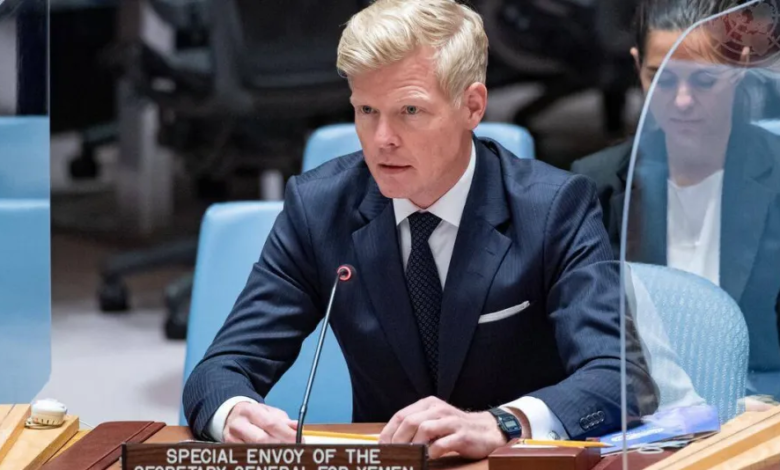
Grundberg intensifies his meetings in Aden to support the Yemeni government's efforts

Introduction to the UN envoy's movements in Aden
The UN envoy to Yemen, Hans Grundberg, is intensifying his diplomatic efforts and meetings in the interim capital, Aden, as part of his ongoing endeavors to support the internationally recognized Yemeni government. These efforts come at a critical juncture, as the Yemeni situation undergoes rapid developments. Grundberg seeks to find common ground that will pave the way for the resumption of a comprehensive political process and an end to the ongoing conflict in the country.
General context and historical background of the Yemeni crisis
In the broader context and historical background of the event, Yemen has been embroiled in a bloody armed conflict since late 2014, following the Houthi group's takeover of the capital, Sana'a, which forced the legitimate government to establish its temporary capital in the coastal city of Aden. Since then, several UN envoys have been tasked with the Yemeni file, culminating in the appointment of Swedish diplomat Hans Grundberg in late 2021. Over the past years, the UN's efforts have focused on establishing a sustainable ceasefire, alleviating the severity of the humanitarian crisis—one of the worst in the world—and addressing the complex economic issues that have burdened the Yemeni people.
The importance of the Grundberg meetings and their local and regional impact
The significance of this event and its anticipated impact are evident on several levels. Locally, the UN envoy's visit to Aden and his meetings with leaders of the Presidential Leadership Council and the Yemeni government constitute crucial political and moral support for the Yemeni legitimacy in the face of formidable challenges. These meetings also aim to unify perspectives on the proposed UN roadmap for peace. Regionally, these developments coincide with mediation efforts led by Saudi Arabia and Oman to bridge the gap between the conflicting parties, making coordination with the government in Aden an indispensable step to ensure the success of any regional agreement. Internationally, the international community views stability in Yemen as a pressing necessity for securing maritime navigation in the Red Sea and the Bab al-Mandab Strait, particularly in light of recent geopolitical tensions.
Economic and political challenges facing the Yemeni government
Meanwhile, Grundberg's meetings in Aden focused on ways to support the Yemeni government in confronting the severe economic deterioration. The government is facing significant challenges, including the decline in the value of the national currency (the Yemeni rial) and the cessation of oil exports, the main source of government revenue, due to attacks targeting export terminals. Therefore, the UN envoy is seeking to mobilize international support for the Central Bank of Yemen and government institutions in Aden to ensure the continued provision of essential services to citizens and the payment of employee salaries, which is crucial for maintaining relative stability in the liberated areas.
The international role in supporting the peace process
In conclusion, Hans Grundberg's intensified meetings in Aden represent a strategic step on a long and complex path toward peace. The success of these efforts depends largely on the willingness of all parties to make the necessary concessions and prioritize the supreme national interest to end the prolonged suffering of the Yemeni people and begin a new phase of reconstruction and development under the umbrella of a comprehensive and just peace that enjoys broad regional and international support.