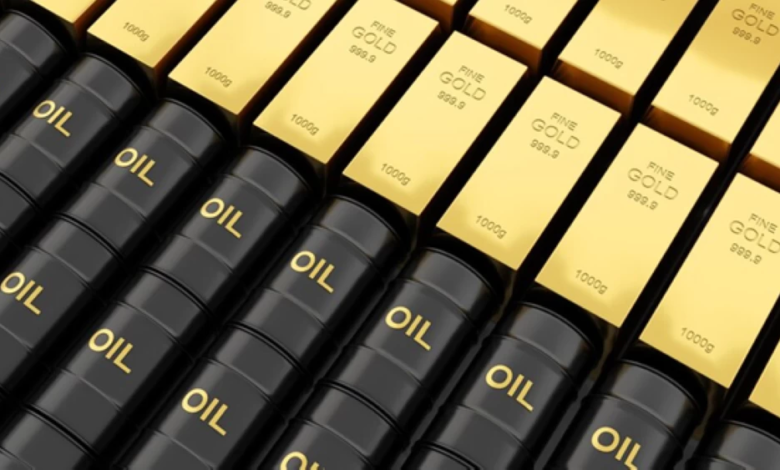

Global markets show mixed performance: precious metals decline, energy rises
Global financial markets are experiencing ongoing volatility, reflecting economic uncertainty, with investors focusing on safe-haven assets and energy sources. In this context, gold prices saw a slight decline in trading on Tuesday, while energy markets showed remarkable resilience, with crude oil prices continuing their strong gains and stabilizing above key levels. This raises questions about the trajectory of inflation and global economic growth in the coming period.
Details of today's gold and precious metal prices
In trading, gold prices were stable on Tuesday with a slight downward bias, as the yellow metal fell 0.1% in spot transactions to $4,640.93 per ounce by 03:27 GMT. Similarly, US gold futures for June delivery declined 0.4% to $4,666.70.
The decline wasn't limited to gold; it extended to other precious metals as well. Silver prices fell 0.9% in spot trading to $72.17 an ounce. Platinum dropped 1.1% to $1,958.75, and palladium lost 0.5% of its value to $1,478.49.
The historical and economic context of the gold movement
Historically, gold and precious metals have been the primary safe haven for investors during times of geopolitical crisis and economic volatility. The prices of these metals are typically influenced by several factors, most notably the interest rate decisions of major central banks, particularly the US Federal Reserve. When interest rates rise, the opportunity cost of holding gold, which does not generate returns, increases, prompting investors to seek other assets. Nevertheless, gold remains a key hedge against inflation, which can impact global economies.
Oil prices continue to soar above $110
Conversely, on the other side of the economic landscape, oil prices continued their strong gains, settling above $110 a barrel. This sustained rise in crude prices reflects a state of tension in global energy markets. Price levels exceeding $100 a barrel are typically associated with supply chain disruptions, major geopolitical conflicts affecting key production regions, and the recovery of global energy demand following periods of recession.
Regional and international impacts of energy prices
This contrast between declining precious metal prices and rising oil prices has profound regional and international implications. Regionally, oil-exporting countries, particularly in the Middle East, benefit from prices remaining above $110, which boosts their revenues, strengthens their budgets, and allows them to finance large-scale development projects. Internationally, the rising cost of energy puts significant pressure on importing countries, leading to increased production and transportation costs, which ultimately translates into higher inflation for the end consumer.
Future outlook for markets
In conclusion, economic analysts are closely monitoring these movements in commodity markets. While the slight decline in gold reflects profit-taking or anticipation of new economic data, oil's resilience above $110 confirms that energy security challenges remain at the forefront of the global landscape. Investors remain vigilant for any geopolitical shifts or monetary decisions that could alter the balance and reshape the price landscape in the coming days.