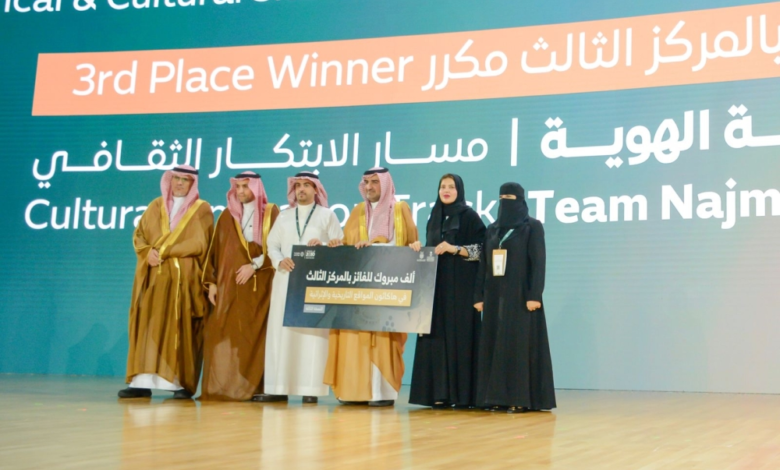
The conclusion of the third season of the Historical and Enrichment Sites Hackathon

Introduction to the importance of enriching the experience of pilgrims
The Kingdom of Saudi Arabia places great importance on developing services for pilgrims to the Two Holy Mosques, stemming from its leading religious and historical position in the Islamic world. As part of its relentless pursuit of the goals of Saudi Vision 2030, particularly the Guests of God Service Program, the importance of integrating modern technology and innovation with the Kingdom's rich historical and cultural heritage is paramount. This strategic approach aims to host millions of Umrah and Hajj pilgrims annually, offering an unforgettable spiritual and cultural experience that introduces visitors to the great Islamic heritage and historical sites of Makkah and Madinah.
Closing ceremony of the Historical and Cultural Sites Hackathon
In this context, Umm Al-Qura University, in fruitful cooperation with the Ministry of Hajj and Umrah, concluded the third season of the Historical and Cultural Sites Hackathon. This distinguished edition launched at the beginning of March 2026 and witnessed significant international and local competition. The closing ceremony and awarding of prizes to the winning teams were held in the presence of prominent figures, most notably the Assistant Minister of Hajj and Umrah, Mr. Al-Hassan Al-Manakhrah, the CEO of the Guests of God Service Program, Engineer Mohammed Ismail, and the Dean of the Institute of Innovation and Entrepreneurship at Umm Al-Qura University, Dr. Ghayda Al-Sulami.
This hackathon was part of the activities accompanying the “Umrah and Visit Forum,” organized by the Ministry of Hajj and Umrah at the King Salman International Conference Center in Madinah, from March 30 to April 1, 2026. The forum served as a global platform that brought together decision-makers and innovators to exchange visions and ideas about the future of Hajj and Umrah services.
Innovative projects and record-breaking achievements in the third season
The hackathon primarily aims to enrich the cultural and religious experience of pilgrims by harnessing innovative minds and providing a stimulating competitive environment. This edition achieved impressive results, reflecting significant international and local interest; nearly 300 applicants participated, and 40 high-quality innovative projects representing more than 32 countries worldwide qualified. To ensure the quality of the outcomes, a select group of 16 judges, 11 trainers, and 10 specialized mentors from various relevant organizations oversaw the evaluation and guidance of the participants.
The hackathon wasn't just about competition; it also included a rich package of accompanying programs designed to hone participants' skills. This package comprised over 50 training courses and enrichment sessions, totaling 380 training hours, along with 20 intensive mentoring sessions and a series of educational trips to historical sites, all of which directly contributed to enhancing the participants' innovative output.
Remarkable competition and crowning of the winning projects
The various hackathon tracks witnessed remarkable competition among creative minds to present technological and design solutions that serve visitors to historical sites. The final results saw a selection of outstanding projects crowned:
- First place: The (Shade) project won first place in the design innovation track, providing creative solutions that contribute to the comfort of visitors.
- Second place: The (My Guide) project won second place in the technical innovation track, which focuses on employing technology to guide and advise pilgrims.
- Third place: The (Riqab) project came in third place in the technical innovation track.
- Third place (repeated): The “Identity Star” project won third place (repeated) within the Cultural Innovation track, highlighting the importance of showcasing Islamic and historical identity.
Expected impact and future prospects
The success of this hackathon is a natural extension of the pioneering role played by academic institutions, foremost among them Umm Al-Qura University, in supporting the innovation and entrepreneurship ecosystem in the Kingdom. Strengthening national partnerships between the academic and governmental sectors effectively contributes to achieving sustainable development goals. These winning projects are expected to have a tangible impact both locally and regionally by transforming these ideas into practical solutions that enhance the services provided to pilgrims and showcase the rich cultural and historical identity of the Kingdom of Saudi Arabia to the world.