Integrity Commission uncovers 11 criminal corruption cases involving millions of riyals in Saudi Arabia

As part of its ongoing efforts to protect public funds and promote transparency and integrity in the Kingdom of Saudi Arabia, the official spokesperson for the Oversight and Anti-Corruption Authority (Nazaha) announced that the Authority has initiated several new criminal cases recently. This step underscores the government's firm commitment to implementing a "zero tolerance" policy on corruption, a cornerstone of the Kingdom's Vision 2030, which aims to ensure a safe and fair investment environment.
Details of the most prominent cases: Millions in bribes in vital sectors
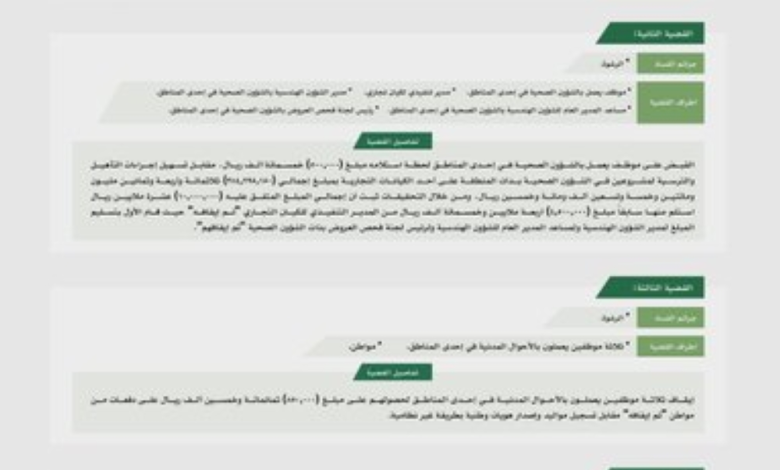
Investigations have uncovered shocking details in 11 diverse cases, most notably a massive financial corruption case involving the Public Investment Fund. A project manager at an entity affiliated with the Fund was arrested after receiving bribes exceeding two million riyals from businessmen in exchange for awarding subcontracts and projects. In the health sector, an employee was caught red-handed receiving half a million riyals as part of a ten million riyal bribe agreed upon to facilitate the awarding of massive projects exceeding 384 million riyals. The arrests in this case extended to senior officials in engineering affairs and the bid evaluation committee.
Violations in the security and service sectors
The cases were not limited to major financial crimes, but extended to include the abuse of power in sensitive service and security sectors. It was revealed that employees in the Civil Status Department were involved in accepting bribes in exchange for issuing national identity cards through irregular means. Additionally, a retired non-commissioned officer was arrested for embezzling more than two million riyals from evidence in previous criminal cases. The cases also included instances of extortion of commercial entities by a Civil Defense employee, and the involvement of military personnel and municipal employees in bribery, forgery, and sham employment of relatives.
Economic and legal dimensions of combating corruption
These seizures are of paramount importance, extending far beyond mere individual punishment; they bolster the confidence of local and international investors in the Saudi market and ensure a level playing field for companies competing for government projects. Uncovering cases of this magnitude sends a clear message that oversight is effective and that the system applies to everyone without exception, whether they are junior employees or senior officials, civilian or military.
The official spokesperson concluded his statement by emphasizing that financial and administrative corruption crimes do not expire with time, and that the Authority is continuing to monitor and apprehend anyone who dares to infringe upon public funds or exploit their position to achieve personal interests, stressing that penalties will be imposed on those involved even after their employment relationship has ended.