Trump reveals the secret behind his bruised hand and boasts about his mental health

In a move aimed at dispelling rumors about his health, US President Donald Trump, 79, once again boasted of his physical fitness and sharp mental acuity. This came after a comprehensive interview in which he defended his complete fitness for office, offering medical explanations for some of the physical observations that had recently drawn media attention.
White House physicians' report and aptitude test
Through his personal social media platform, Truth Social, Trump shared his latest medical assessments with his followers, asserting that White House doctors had confirmed his "excellent health." Not only that, but he proudly noted passing the cognitive abilities test for the third consecutive time, emphasizing that he answered all the questions correctly. Trump considered this achievement to place him among the top presidents and vice presidents, a clear indication of his desire to demonstrate his mental and physical superiority.
The secret of bruises and aspirin
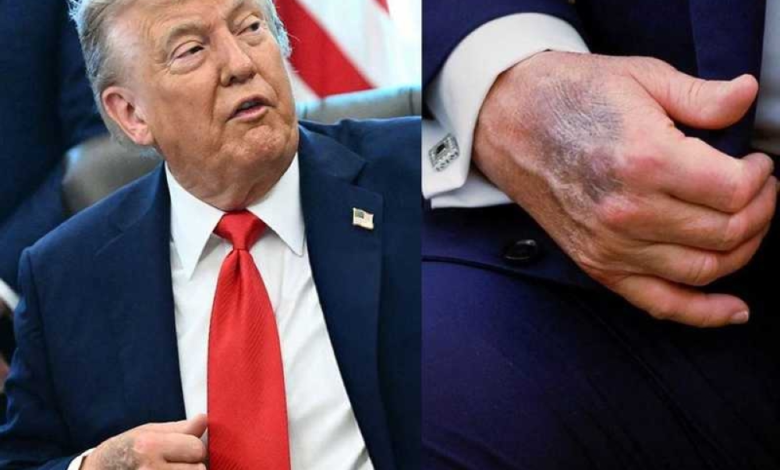
In a related development, The Wall Street Journal addressed the recurring bruises on Trump's right hand, which were often covered with bandages or layers of cosmetics, as well as observations about swelling in his ankles. In his first direct response to this issue, Trump attributed the bruising to his aspirin use, a common medical explanation since aspirin is known to thin the blood, which can make bruising more common, especially in older adults. Trump also corrected a previous statement, clarifying that the scan he underwent in October was a CT scan, not an MRI.
The truth about "sleeping" in meetings
In response to televised footage showing him appearing to fight off sleep or close his eyes during official meetings, including an Oval Office meeting with health officials, Trump categorically denied falling asleep. He described those moments as simply "relaxing" and focusing, telling the newspaper, "I just close my eyes; it relaxes me," denying any decline in his alertness or attention.
Political context and the importance of presidential health
Trump's remarks take on particular significance given the ongoing debate surrounding the ages of political leaders in the United States. Historically, the health of American presidents has been the subject of intense scrutiny, from Franklin Roosevelt's concealment of his illness to questions surrounding the health of John F. Kennedy and Ronald Reagan. In the modern era, with the increasing average age of presidential candidates, health transparency has become a key criterion for American voters to ensure a president's ability to make critical decisions affecting national and global security.
Demanding mandatory testing
Trump used the occasion to call for new eligibility standards, demanding that any presidential or vice-presidential candidate undergo a “rigorous and proven” cognitive test. He wrote sharply, “Our great country cannot be run by stupid or incompetent people.” This statement is widely interpreted as a veiled and continued attack on his predecessor, Joe Biden, who withdrew from the 2024 race after debate performances that raised widespread concerns about his age, reflecting Trump’s strategy of using the “health card” as a tool for political gain.