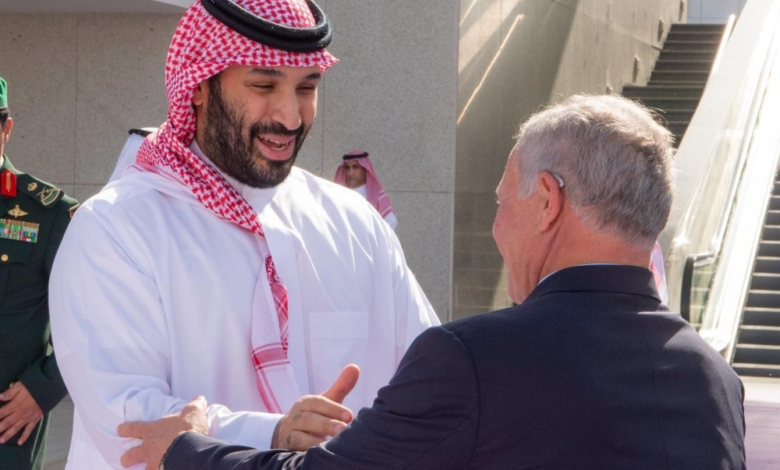
The Crown Prince bids farewell to the King of Jordan and the Emir of Qatar upon their departure from Jeddah

The leaders departed and bid farewell to the Crown Prince in Jeddah
His Majesty King Abdullah II bin Al-Hussein of the Hashemite Kingdom of Jordan and His Highness Sheikh Tamim bin Hamad Al Thani, Emir of the State of Qatar, departed Jeddah today following an official visit that reflects the deep-rooted fraternal and historical ties between their two countries and the Kingdom of Saudi Arabia. Among those who bid them farewell at King Abdulaziz International Airport was His Royal Highness Prince Mohammed bin Salman bin Abdulaziz Al Saud, Crown Prince and Prime Minister.
Regional context and the importance of joint coordination
This visit comes at a crucial time, as the Middle East region faces rapidly escalating geopolitical challenges that necessitate high-level coordination among Arab leaders. Jeddah, a city long known for hosting pivotal summits and diplomatic meetings, serves as a stage for strengthening joint Arab action. The meetings between the Saudi leadership and their Jordanian and Qatari counterparts aim primarily to unify visions and positions on regional and international issues, foremost among them efforts to de-escalate tensions and establish peace in the region.
Regionally, Saudi-Jordanian-Qatari coordination is a cornerstone of maintaining regional stability. Saudi Arabia, with its political and economic weight, plays a leading role in spearheading diplomatic efforts to de-escalate tensions. Jordan, for its part, plays a pivotal role in protecting holy sites and supporting regional stability, while Qatar stands out as a key diplomatic player in mediation efforts. The convergence of these political wills enhances the prospects for achieving security in the Middle East.
The historical and economic dimensions of the relations
Historically, Riyadh has enjoyed deep-rooted strategic relations with Amman and Doha, built on mutual respect and shared interests. Recent years have witnessed a remarkable development in these relations, culminating in economic agreements and investment partnerships aligned with Saudi Arabia's Vision 2030 and the development plans of both Jordan and Qatar. This economic cooperation not only benefits the three countries but also contributes to strengthening broader Arab economic integration.
Furthermore, joint committees between Saudi Arabia and both Jordan and Qatar play a vital role in monitoring the implementation of bilateral agreements across various sectors, including energy, education, technology, and investment. This advanced level of cooperation ensures the sustainability and development of relations, serving future generations and contributing to the creation of new job opportunities and the strengthening of national economies.
International influence and diplomatic messages
Internationally, world capitals are closely watching the outcomes of the meetings held in Saudi Arabia, given their direct impact on global energy markets and global security. Crown Prince Mohammed bin Salman's personal farewell to the Kingdom's guests reflects longstanding Saudi diplomatic traditions and underscores the high regard in which the leaders of Jordan and Qatar are held by the Saudi leadership.
In light of current global transformations, the importance of building strong regional blocs capable of negotiating and protecting Arab interests in international forums is paramount. Therefore, the continuation of these meetings and reciprocal visits between leaders is a strong indicator of the dynamism of Arab diplomacy and its ability to adapt to changes and formulate proactive strategies that guarantee Arab national security and drive comprehensive and sustainable development.